Iterable
When to use Iterable
Iterable's primary benefit is that it enables non-technical team members to iterate on notification copies and perform experiments. Thus its primary use case right now is Marketing notifications, though it is being used to send non-Marketing notifications, too.
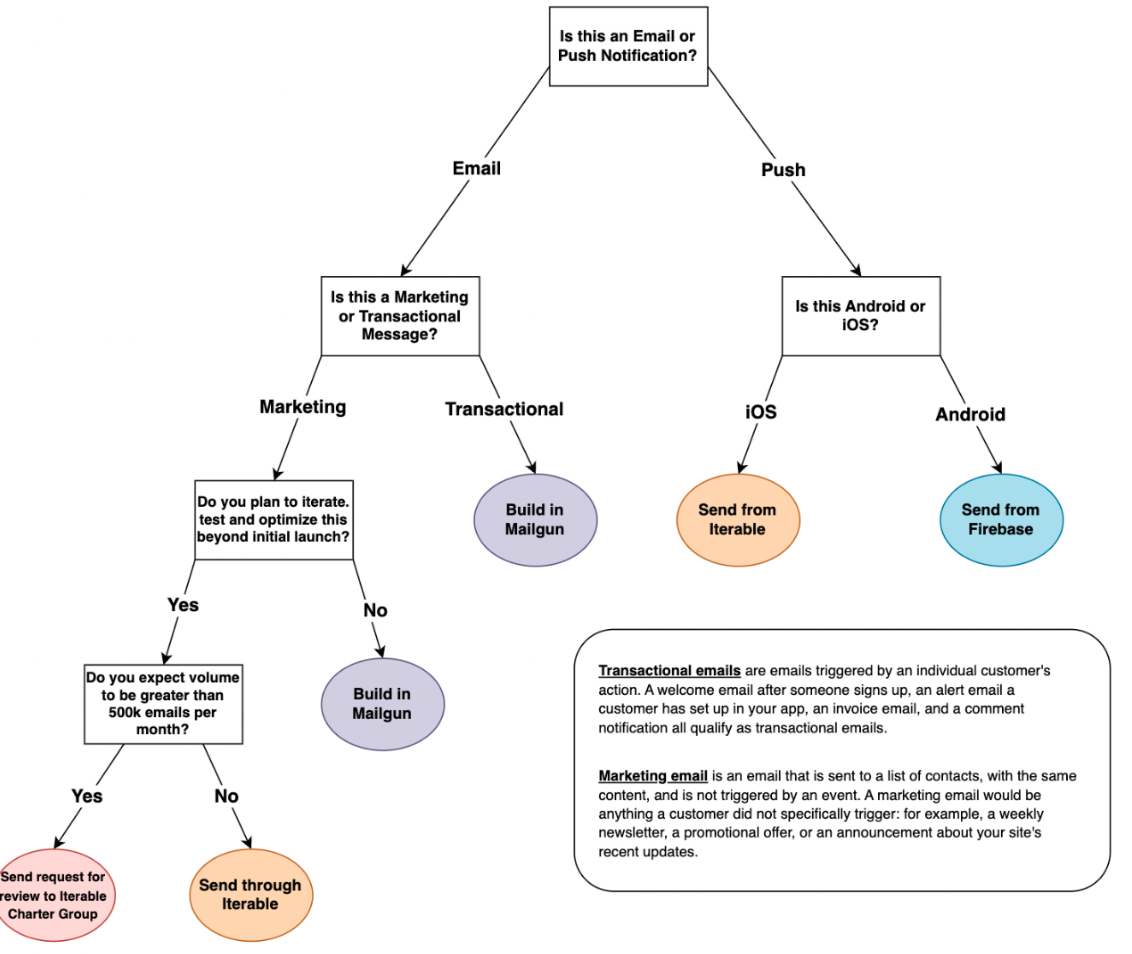
When deciding whether or not to send a new notification through Iterable, talk to our team at #ask-notifications, as our send strategy is in flux.1 The following flow chart can serve as a loose guide:
How we use Iterable
We use Iterable to send push notifications to student users and email notifications to all user types. We use most Iterable features — including custom events, campaigns, journeys, and templates. We do all this through the Iterable app and Iterable API, which we connect to in our own codebase's Iterable::IterableApi & Next::Notifications::IterableApi. Our primary use cases for Iterable today include Marketing emails and emails to Employer users.
Trigger types: API vs custom event
Though a bit of a misnomer, we often use the term “Iterable API sends” to describe direct sends by campaign id through POST /email/target and POST /push/target requests to the Iterable API, distinct from the more recently implemented Custom Event (POST /events/track) + Journey flows.
We discourage creating new notifications through the campaign id flow, but we continue to use it to send legacy Student emails (mostly Activity-related), Student push notifications, and 1 Employer email. iterable_template.rb holds an exhaustive list of such sends. More details in our notifications catalog.
Next::Notifications::IterableApi (NMS)
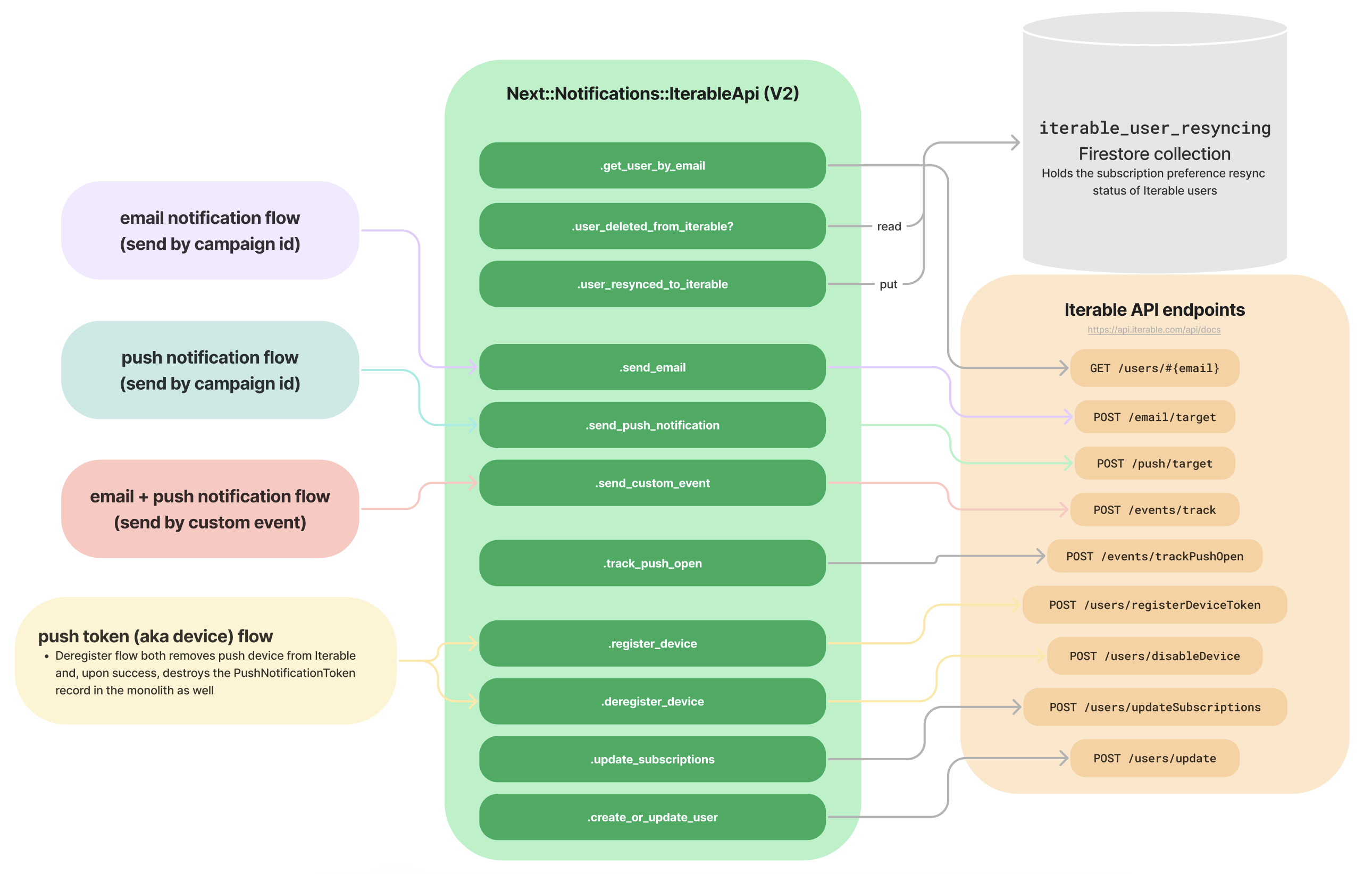
What does Next::Notifications::IterableApi do?
- Sends notifications
- Creates Iterable profiles
- Updates Iterable profile devices and subscriptions
- Interacts with Firestore
- Sends push open events back to Iterable
- Gets users from Iterable
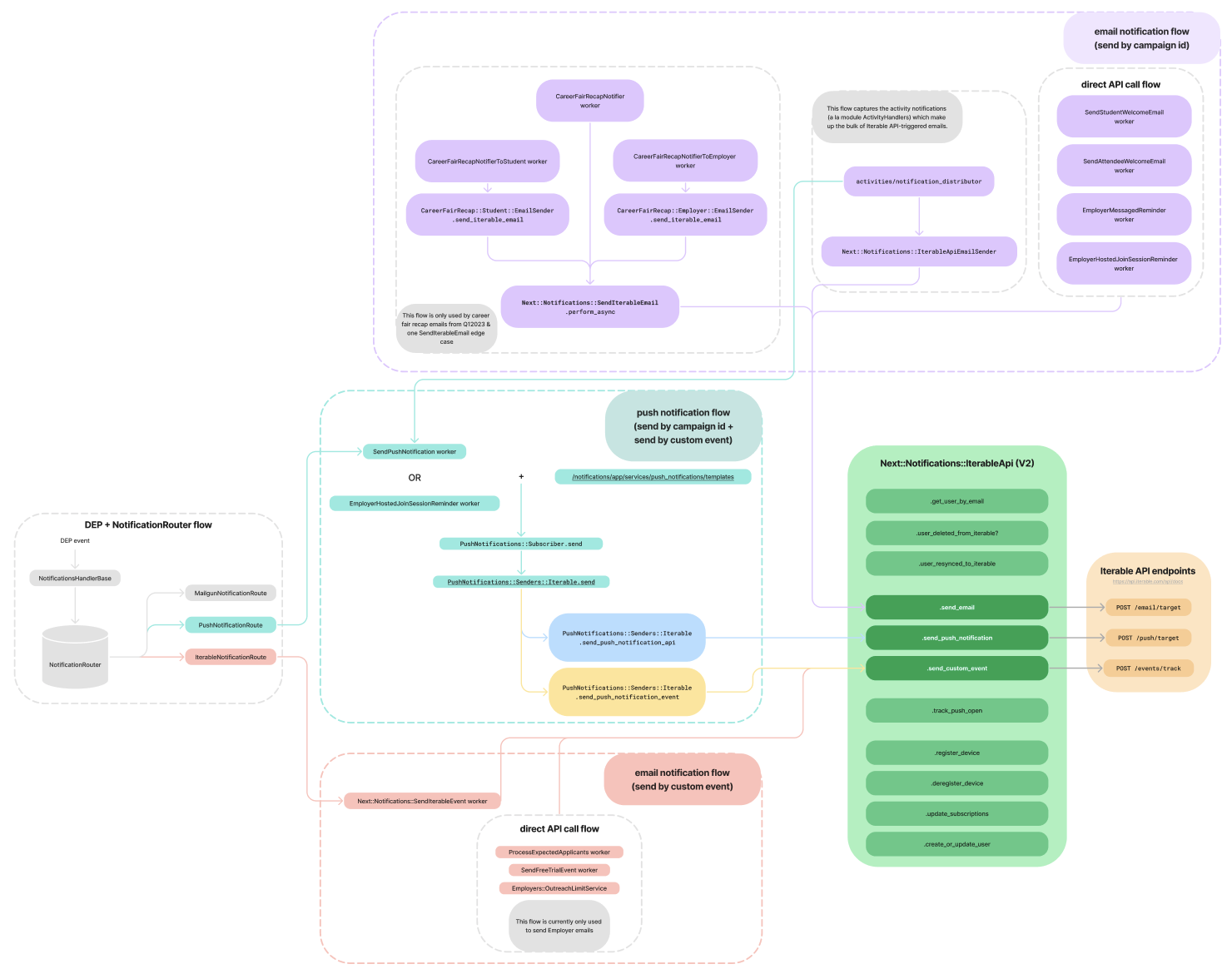
When it comes to notifications, Next::Notifications::IterableApi...
- Sends push notifications to students
- Sends email notifications to all user types
- Sends through both custom events and directly by campaign id, across channels and user types
Here's a diagram of how notifications move through the NMS IterableApi:
Iterable::IterableApi (monolith)
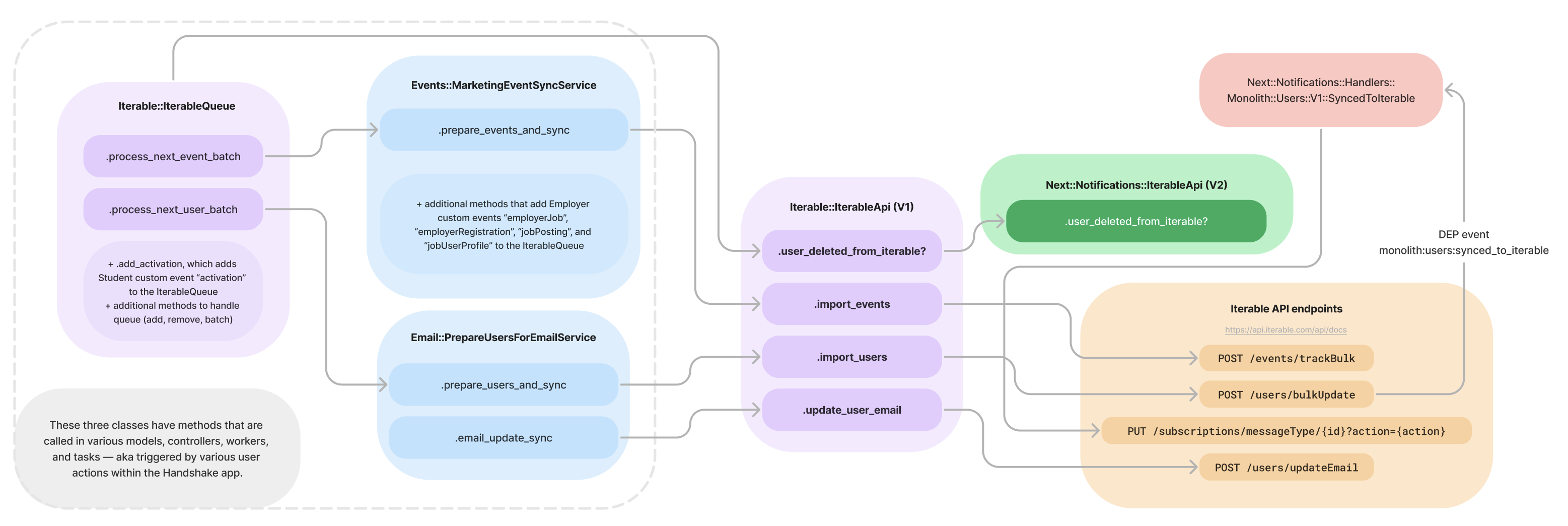
This is the original IterableApi architecture, created in 2020, pre-NMS, NDS, and NSS. It is connected to an IterableQueue as well as core architecture (for example, connected to fundamental Models’ after_commit hooks (i.e. User, Job)). This is the primary way that user profiles are created in Iterable besides offline DAGs.
What does Iterable::IterableApi do?
- Sends notifications
- Creates Iterable profiles
- Updates Iterable profile email address
When it comes to notifications, Iterable::IterableApi...
- Only sends email notifications, and only to Students and Employers
- Only sends through Iterable custom events feature2
We plan to combine Iterable::IterableApi with Next::Notifications::IterableApi, though not currently a priority.3
iterable_student_sync DAG
The iterable_student_sync DAG creates user profiles on our Iterable "Student - US" project and syncs most profile attributes.
- Criteria is defined in the DBT model
- Uses Iterable API
POST /api/users/bulkUpdateendpoint - Runs daily at 10PM PT
- Writes to BigQuery handshake-production.handshake_derived.iterable_student_sync daily, but with a delay
- Does not touch device arrays (how Iterable stores push tokens) or subscription preferences
- AKA IterableStudentSync; FKA iterable_user_sync, IterableUsersSync, iterable_student_user_sync
iterable_user_deletion DAG
The iterable_user_deletion DAG deletes student users from Iterable.
- Criteria is defined in Iterable: Contacts Removal List
- Runs daily at 2PM PT, can take up to 5 hours
- Writes to BigQuery iterable_historical_deleted_users (historical data: iterable_historical_deleted_users_snapshot)
- Additional resources:
iterable_resync_notification_preferences DAG
The iterable_resync_notification_preferences DAG resyncs subscription preferences for deleted relevance users
- Criteria is defined in the DBT model
- Uses Iterable API
POST /api/users/bulkUpdateSubscriptionsendpoint - FKA iterable_resync_users, iterable_user_resync
The "resynced" column in iterable_historical_deleted_users BigQuery table & iterable_user_resyncing Firestore collection are a reference to this DAG. A truthy value in such columns signals that subscriptions have been resynced, not necessarily profile existence, creation, or recreation.